
Booksy has built its reputation on one thing above all: a consumer app that puts your business in front of people actively searching for a haircut, a beard trim, or a beauty appointment nearby. Founded in Poland in 2014 and now headquartered in the US, it’s grown into one of the largest beauty-focused booking marketplaces in the world, with particular strength in the barbershop segment. It’s less a calendar and more a client-acquisition channel. But the marketplace comes with trade-offs — commissions, per-staff fees, and the fact that your clients see competitors every time they open the app. Here’s our honest Booksy review.
Last verified: July 2026, directly against Booksy’s official pricing page (biz.booksy.com), plus hands-on testing of a Booksy Biz trial account.
Booksy at a glance
| Category | Details |
|---|---|
| Pricing structure | One single plan — no feature tiers. All features included at the base price. |
| Starting price | $29.99/month + tax for the first user |
| Extra staff | $20/month per additional team member |
| Free trial | 14 days, no credit card required |
| Marketplace | One of the largest beauty-focused consumer marketplaces; Booksy operates in ~30 countries |
| Boost commission | Optional — 30% one-time commission on a new client’s first booking (min $10, max $100 per client) |
| Best for | Barbershops and independent stylists wanting marketplace exposure |
| Weak spot | No built-in payroll; clients must create a Booksy account to book |
How much does Booksy cost?
Confirmed directly on Booksy’s official pricing page: there’s just one plan, not a set of feature tiers. Every Booksy Biz account, at $29.99/month + tax for the first user, gets full access to every feature — marketing tools, messaging campaigns, waitlists, gift cards, and everything else Booksy offers. Nothing is held back for a higher tier. Adding team members costs $20/month per additional person; a solo professional pays about $359.88/year before processing and any optional extras, while a three-person team would add roughly $40/month in staff fees on top of the base plan.
One thing worth knowing if you’re comparing notes with someone abroad: Booksy’s pricing varies by region. The figures above are for the US market. In the UK, for example, Booksy Biz runs at a different monthly rate with a shorter trial window, and other European markets differ again. If you find a Booksy price quoted somewhere that doesn’t match this, check which country it refers to before assuming it’s outdated.
On top of the subscription sit two other costs to budget for: card processing fees, and the Boost commission. Booksy’s processing rates range from about 2.49% + $0.10 per transaction (card reader) up to 2.69% + $0.30 (mobile payments on saved cards), depending on how the payment is taken. Boost itself is optional and free to turn on — you only pay when it works: a one-time 30% commission on a new client’s first visit, with a $10 minimum and a $100 maximum per client. After that first booking, every future visit from that client is commission-free.
What Booksy does well
The marketplace is the whole point. Booksy’s consumer app has genuine demand behind it, especially for barbershops and hair salons in populated urban areas. If new clients discover you by searching the app, that’s revenue a direct-only booking tool simply can’t replicate. For a new or growing business hungry for foot traffic, that exposure can be worth the commission.
Simple, and everything is included. There are no feature tiers to navigate — every account gets the same full toolset — and SMS reminders are part of the plan rather than metered credits you top up separately.
What setting up Booksy is actually like
We set up a Booksy Biz trial account to see how the software behaves rather than just reading the feature list. Here’s what stood out.
Signing up asks for less than you’d expect. Booksy wants an address, an email, and a phone number, and it verifies the last two. That’s it — no credit card, no bank details, nothing tied to payment processing. The “no credit card required” claim on the pricing page holds up in practice, which isn’t always true of software trials.
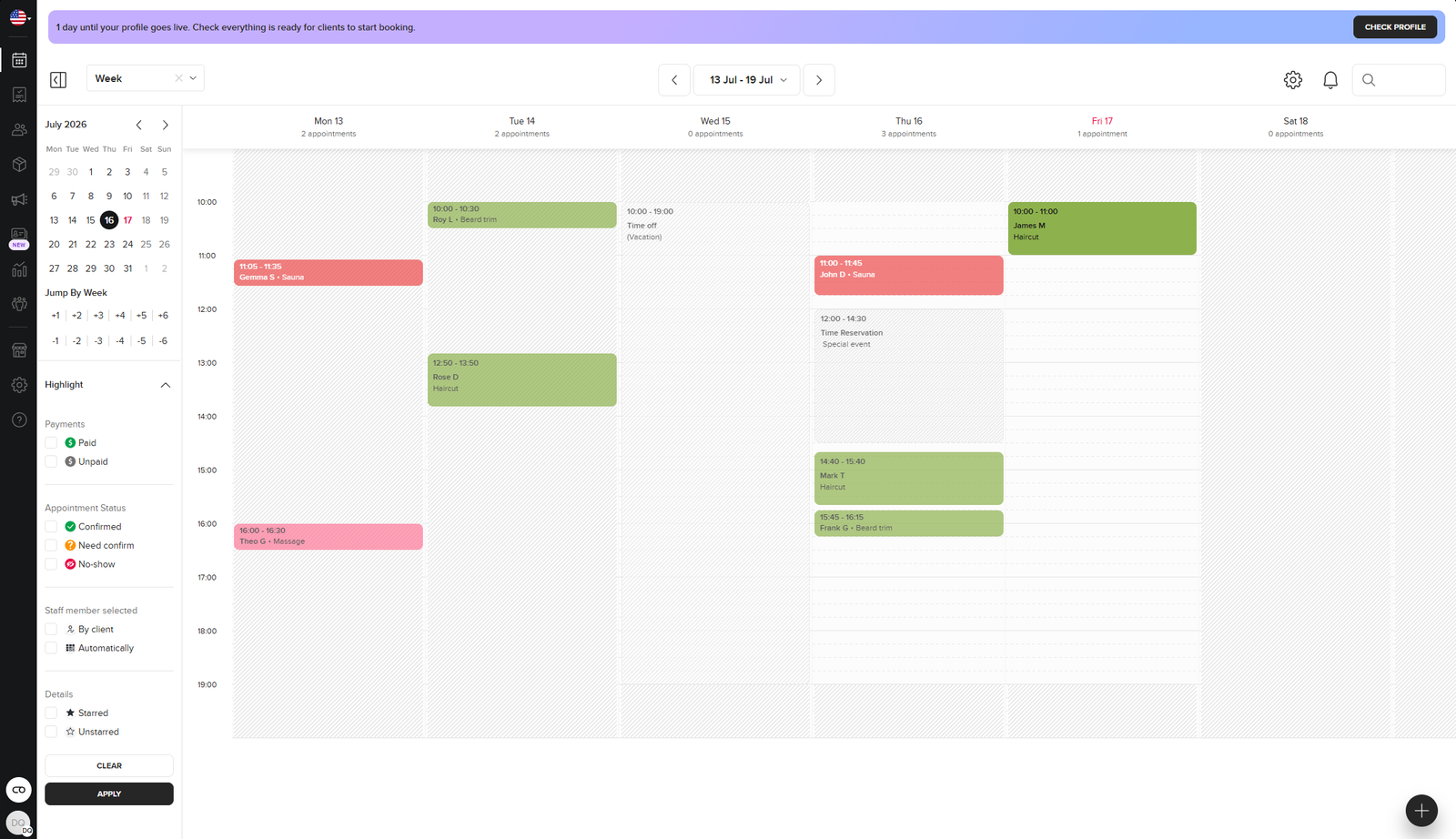
You’ll have a working week set up in about 15 minutes. Getting the basics running — business hours, a couple of services, the calendar view — is genuinely quick and doesn’t need a tutorial. Booking an appointment is about as simple as it gets: pick a slot, pick a service, done. This is a platform built for someone who wants to be cutting hair, not learning software.
The full setup is a different story — and that’s normal. Importing your existing client list, building out your complete service menu, configuring your public-facing profile, setting up staff permissions, learning the reporting side: that’s an afternoon, not 15 minutes. Booksy nudges you through it with a gamified “Profile Completeness” tracker, which is a reasonable way to handle it. Just don’t plan to migrate a busy salon over a coffee break.
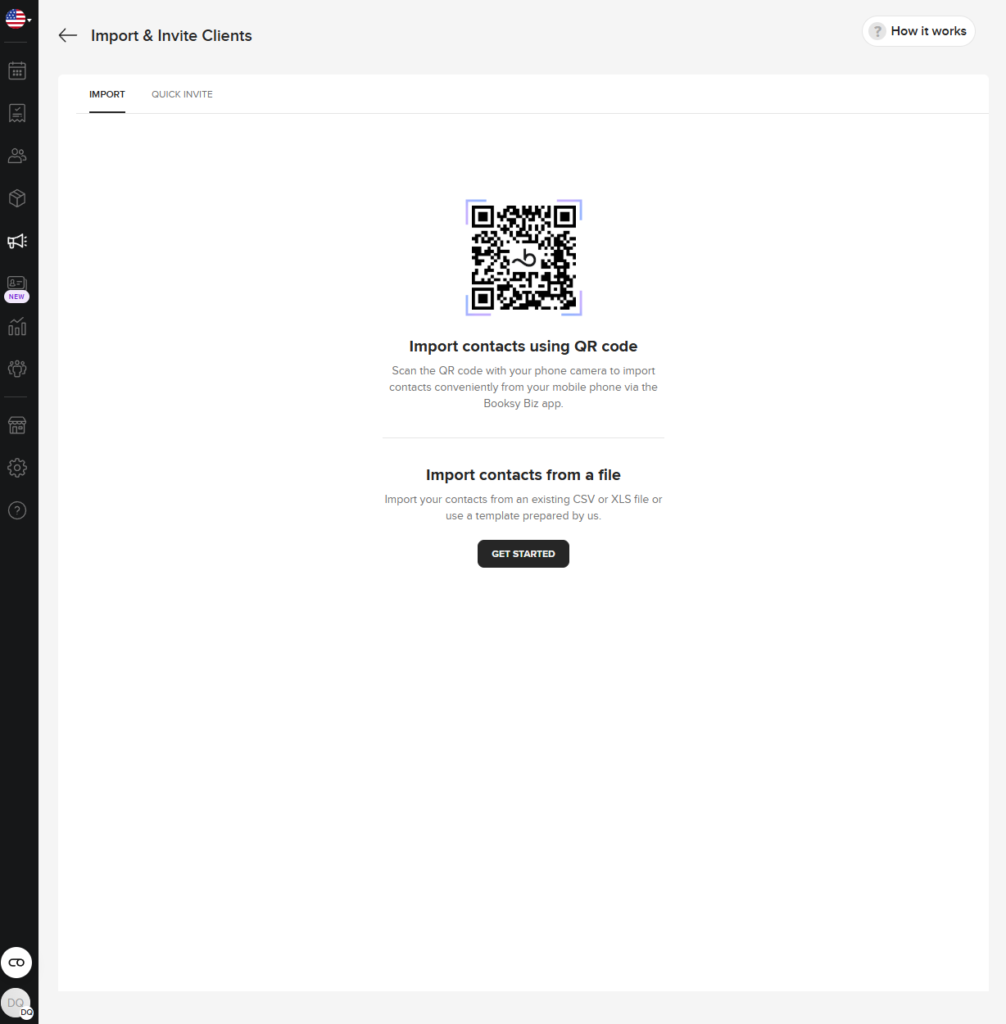
Client migration is better supported than we expected. Booksy lets you import contacts from a CSV or XLS file (with a template provided), or scan a QR code to pull contacts straight off your phone through the Booksy Biz app. If you’re switching from another platform and dreading the data move, this is one of the smoother implementations in the category.
Your profile may not go live immediately. After signup on our trial, a banner counted down the days until the business would appear in the marketplace and clients could start booking. It wasn’t a long wait, but if you’re signing up expecting bookings the same afternoon, check the timeline for your market first.
The reporting is deeper than the price suggests. The stats dashboard breaks out appointments, occupancy, revenue by category (services, products, tips, gift cards, memberships, packages), cash flow, inventory, staff, and marketing — with forecasting. For a platform at this price point aimed largely at solo operators, that’s more analytical depth than you’d assume.
Scope of our testing: we used the web dashboard on a trial account to evaluate setup, scheduling, and navigation. Our trial was on a European account — Booksy is the same product globally, so the interface, setup flow, and features described here are what you’ll see, but region-specific details (trial length, pricing, and possibly profile activation timing) follow your local market, and the figures in this review are the US ones taken from Booksy’s US pricing page. We didn’t test the mobile app, payment processing, or the marketplace with real clients — so where this review discusses those, it reflects Booksy’s documentation and other users’ reported experiences rather than our own.
Where Booksy falls short
- You’re advertising competitors to your own clients. Every time a client opens the app to rebook, Booksy also shows them nearby alternatives — and businesses paying for Boost appear above you. For an established shop with a loyal base, the marketplace can do more harm than good.
- Your clients need a Booksy account to book. Anyone booking an appointment has to create an account first — a friction point competitors with guest checkout don’t impose.
- No built-in payroll. You’ll need a separate tool (like Gusto or Square Payroll) if you want to run staff pay through your system.
- Per-staff fees add up. The $20/month per extra team member is one of the steeper staff surcharges in this category, which makes larger teams more expensive than a flat-rate plan.
- No refunds once you subscribe. Booksy doesn’t refund subscription payments, so use the 14-day trial properly before committing.
- You don’t own the client relationship. Booksy sits between you and your clients as the communication channel, which limits your control.
What real users complain about
Marketing pages tell you what a platform does. Reviews tell you what it’s like to live with. Across hundreds of verified reviews on independent platforms like Software Advice, GetApp, and Capterra, the same themes come up repeatedly — and they’re worth knowing before you commit:
- Payouts and payment friction. The most common complaint cluster involves money movement: slow payouts, transaction fees users describe as inconsistent, limited control over deposit settings, and payment eligibility issues in certain regions. If cash flow timing matters to you, ask about payout schedules specifically before signing up.
- Customer support is divisive. Reviews split sharply here. Some users praise the onboarding and describe support as thorough and accessible; others report poor service and unprofessional handling, particularly when they hit a problem after migrating from another platform. Your experience may depend heavily on which support agent you get.
- Fees feel confusing. Even reviewers who consider Booksy affordable often say the fee structure is hard to follow once processing rates, Boost commissions, and staff surcharges stack up. The subscription is simple; the total cost isn’t.
On the positive side, the recurring praise is consistent too: reviewers repeatedly highlight how much admin time the automated reminders and 24/7 self-booking save them, and how much easier client records are to keep organized than with a paper book or a generic calendar app.
Best Booksy alternatives
- Vagaro — another marketplace-first platform with a broader all-in-one feature set. See our full Vagaro review.
- Fresha — lower subscription and marketplace commission model, appealing for solo barbers watching every penny.
- GlossGenius — flat pricing and a branded, direct booking page if you’d rather keep client relationships fully your own, without a marketplace.
- Square Appointments — free for a single location and simple if you’re already using Square.
For the full side-by-side picture, see our complete salon and spa software comparison.
Who should use Booksy — and who shouldn’t
Booksy’s value depends almost entirely on one question: do you need new clients, or do you need to manage the ones you have?
- Good fit: a new or growing barbershop. If your chair has gaps and you’re in a city where people search the app, the marketplace does something no direct-only tool can. A 30% one-time cut on a first visit is a reasonable acquisition cost if that client comes back for years.
- Good fit: a solo stylist who wants one simple bill. One plan, every feature, no tier decisions. At $29.99/month with no per-feature upsells, the pricing is genuinely simple for a single operator.
- Poor fit: an established salon with a full book. If you’re already turning clients away, you’re paying to be listed next to your competitors and gaining little. A direct booking tool with a branded page serves you better.
- Poor fit: a larger team. At $20/month per extra person — among the steepest staff surcharges in the category — a seven-person salon pays $149.99/month before processing. Flat-rate competitors get cheaper as you grow; Booksy gets more expensive.
Frequently asked questions
Is Booksy good for barbershops?
Yes — Booksy is one of the top-rated booking platforms for barbershops specifically. Its consumer app has strong penetration in the barbershop and hair salon segments in major US cities, making it a genuine source of new-client discovery for grooming businesses.
How does Booksy Boost work?
Boost is Booksy’s marketplace visibility feature. It’s free to switch on, and you only pay when it works: a one-time 30% commission (minimum $10, maximum $100) on the first visit of any new client who books through it. After that first appointment, future bookings from that client are commission-free — so Boost works like a client-acquisition cost rather than an ongoing fee.
Does Booksy have different pricing tiers?
No — Booksy’s official pricing page confirms a single plan structure. Every account pays $29.99/month + tax for the first user (plus $20/month per additional staff member) and gets full access to all features, with nothing gated behind a higher tier.
Does Booksy have a free plan?
No permanent free tier, but there’s a 14-day free trial with no credit card required. Paid plans start at $29.99/month + tax.
Last updated: July 2026. We periodically re-verify pricing and features; if you spot something outdated, let us know.